
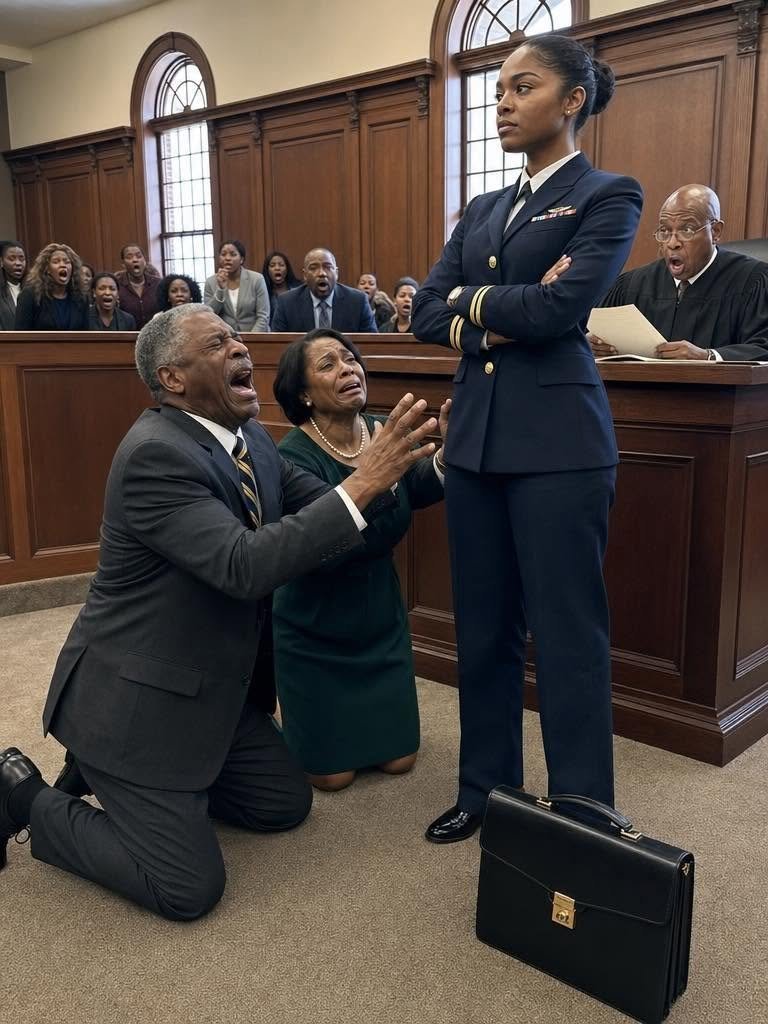
PART 1
When I entered the courtroom that afternoon, they barely tried to hide their contempt.
They were convinced they had already won.
The judge then lowered his eyes to my file, froze for a moment, then uttered in a calm voice a single sentence that plunged the entire room into a deathly silence.
My grandmother left me $4.7 million.
This is not a symbolic gift.
Not a vague promise.
A legally binding inheritance that designated me — and me alone — as the legitimate beneficiary.
As soon as my parents found out, they filed a lawsuit.
These were the same parents who had treated me for years as a mere afterthought.
These same parents who celebrated every small success of my brothers and sisters while attributing mine to chance.
These same parents who forgot my birthdays, ignored my achievements and called me “difficult” every time I refused to be controlled.
So when I received the notice of contestation of the will, I was not surprised.
When I read their accusations — that I had manipulated my elderly grandmother and was incapable of responsibly managing such a large inheritance — I felt something far colder than anger.
I felt a certainty.
The hearing took place four months later.
I arrived early.
No designer clothes.
No valuable jewelry.
Nothing that attracted attention.
A simple anthracite suit, neatly arranged files and a calm expression.
I sat down without saying a word.
A few minutes later, my parents came in with their lawyer.
The confidence emanated from them.
My mother immediately spotted me and rolled her eyes.
My father didn’t even try to hide his hostility.
“She doesn’t deserve a penny,” he announced loudly enough for several people nearby to hear. “She’s always caused trouble.”
Their lawyer smiled politely.
For him, it was a simple matter.
To all of them, I was still the same girl they had underestimated for decades.
Calm.
According to.
Easy to master.
The procedure has begun.
Their lawyer spoke first.
He portrayed me as unstable, irresponsible, and capable, in one way or another, of convincing my grandmother to disinherit her own children.
He spoke with absolute confidence.
As if my character had already been chosen.
I did not interrupt.
I didn’t argue.
I simply listened.
And I waited.
The judge then began to examine the case file.
He turned a page.
Then another one.
Suddenly, he stopped.
His gaze remained fixed on a single document.
Several long seconds passed.
Then he slowly raised his eyes towards me.
Silence fell in the courtroom.
My parents exchanged perplexed glances.
The judge leaned back slightly and narrowed his eyes.
“Wait a moment,” he said cautiously.
His gaze never left mine.
“Are you JAG officer Rebecca Lawson?”
Read more on the next pagePART 2
When I walked into the courtroom, they looked at me with open contempt, certain they would win. The judge paused, reviewed my file, and whispered a single sentence. A dead silence fell over the room. My grandmother had left me 4.7 million dollars. Not a symbolic sum. Not something vague or sentimental. A clear, legally established will that designated me—and me alone—as the primary beneficiary. And as soon as my parents found out, they sued me. Those same parents who had ignored me my whole life. The ones who praised my siblings’ smallest achievements while calling mine “luck.” The ones who forgot my birthdays, disparaged my career, and called our relatives “difficult” whenever I refused to back down. When I received the notice contesting the will, I wasn’t surprised. But when I read their accusation—that I had “manipulated an elderly woman” and was “mentally unfit to manage such a sum”—I felt something colder than anger.
On the day of the hearing, I arrived early. I wore a conservative suit. No jewelry. No visible status. I took my seat discreetly, files neatly arranged, expression neutral. My parents walked in together, whispering to their lawyer, beaming with confidence. Seeing me, my mother openly sneered. My father didn’t even bother to hide his disdain. “She doesn’t deserve a penny,” he said loudly enough for everyone to hear. “She’s always been trouble.” Their lawyer smiled politely, already convinced this would be simple. In their eyes, I was still the same girl they had ignored for decades: quiet, obedient, easy to manipulate. The judge entered. The formalities began. My parents’ lawyer spoke first. He painted me as unstable, irresponsible, someone who had “somehow convinced” my grandmother to exclude her own children. He spoke with confidence, as if my character were already a proven fact. I said nothing. I listened. I waited. Then, as the judge reviewed the file, she paused. Her gaze lingered longer on one page than the others. She looked up. And she said slowly, “Wait… you are a general counsel…”
”Thank you, Ms. Vance,” Sterling said in a smooth voice. He turned to me with a predatory smile. “Your witness.” I stood up. “No questions at this time, Your Honor.” A murmur of confusion rippled through the courtroom. My mother looked insulted that I wasn’t defending myself. Judge Halloway frowned. “Ms. Vance, are you sure? This testimony is damning.” “I am sure, Your Honor.” My father spoke next. He was more aggressive. “My mother was senile,” he declared. “She didn’t know what day it was. Elena took advantage of her. Elena has always been the black sheep. She’s… bizarre. Asocial. She wouldn’t be able to keep a job at a fast-food restaurant, let alone manage an estate…” “And did you visit your mother often?” Sterling asked. “As often as possible,” my father lied smoothly. “But Elena blocked us! She changed the locks!” I made a note on my notepad. Perjury count #1: It was the nursing home that changed the locks, not me. “Your witness,” Sterling said. “No questions, Your Honor.”
”I repeated myself. My father stared at me with contempt as he stepped down. He thought I was paralyzed by fear. He thought his presence, his suit, his loud voice intimidated me. He didn’t know I was simply letting them log their lies into the official court record. During a deposition, lies cause problems. At trial, lying is a crime. Sterling called a “medical expert”—a doctor who had never met Nana Rose but had reviewed her file “for a fee.” He claimed that, given her age, she must have been easily influenced. “The defendant likely used emotional manipulation techniques,” the doctor speculated. “No questions,” I repeated…
Nana Rose’s funeral felt less like mourning an adored matriarch and more like a fashion show for my mother’s vanity.
The rain fell in a fine, persistent drizzle over the cemetery, turning the earth into slick mud. I stood at the back of the small crowd, sheltered under a simple black umbrella, wearing a basic wool coat bought from a department store years ago. I watched my mother, Linda, in the front row. She was draped in a black fur coat that cost more than my first car, wiping dry eyes with a lace handkerchief, glancing out of the corner of her eye to see if local high society figures were attending the service.
Beside her stood my father, Robert. He seemed impatient, checking his watch every few minutes, no doubt calculating how long it would take to get to the reception and the open bar. To them, Nana Rose was a burden in life and a windfall in death. They hadn’t visited her at the nursing home in three years, using “business trips” and “emotional distress” as excuses.
I missed her. The ache in my chest was like a physical weight. I missed the Saturday afternoons spent playing chess on the porch. I missed her sharp wit, her wartime stories, and the way she would squeeze my hand whenever my parents made a disparaging remark about my life choices.
”She’s in a better place,” my mother announced loudly as the casket was lowered, ensuring her voice carried to the back of the crowd.
I remained silent. I knew the better place was anywhere far away from them.
Two days later, we met in the plush, mahogany-paneled office of Mr. Henderson, the estate attorney. The air was thick with the scent of old paper and greed.
My parents sat on the leather couch, holding hands, looking hopeful. I sat on a stiff wooden chair in the corner. I was the outlier in the room: Elena, the daughter who moved away, the one who didn’t marry a doctor or a banker, the one whose job was “some administrative thing, super boring,” according to my mother.
Mr. Henderson cleared his throat and adjusted his glasses. “I will now read the last will and testament of Rose Vance.”
He went through the standard boilerplate language. Then, he reached the distribution of assets.
”To my son, Robert, and his wife, Linda, I leave the contents of my storage unit in Queens, which contains the family photo albums and my collection of porcelain cats.”
My father blinked. “Is that… is that the preamble?”
”That is the entirety of your bequest,” Mr. Henderson stated calmly.
”What?” My mother’s voice pitched higher. “But… the portfolio? The brownstone in Brooklyn? The trust?”
Il resto è nella pagina successiva
