
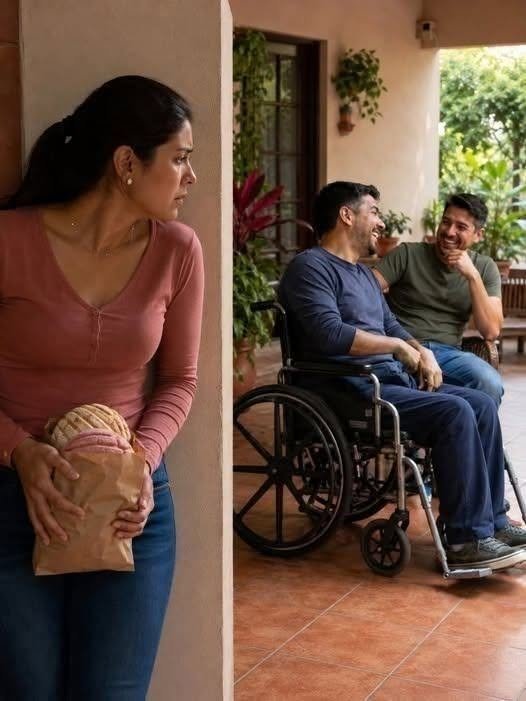
That was the closest thing to peace.
A year later, my living room no longer looked like a hospital room.
I put a yellow armchair in.
I bought plants.
I hung light-colored curtains.
I started wearing perfume again.
I started wearing tight dresses again, not to please anyone, but to remind myself that my body was not just a tool for care.
I also started a nursing assistant course.
I cried in the bathroom during the first class.
I thought I would hate everything related to caring.
But not.
What she hated was caring without respect.
Care tirelessly.
Taking care of someone who mocked my hands while I depended on them.
The teacher talked about the caregiver breakdown and I felt like she was reading my story out loud.
I didn’t raise my hand.
Not yet.
But I wrote in my notebook:
“I wasn’t a nurse for free. I was an exploited woman who learned late in life to charge for her freedom.”
Some time later I received a letter from Esteban.
He sent it from the center.
I didn’t open it as soon as it arrived.
I left it on the table for three days.
When I finally read it, it said:
“Brenda:
Everyone here gets paid to look after me. No one can guess. No one runs if I scream. No one hates me, but no one obeys me out of love.
I think that’s what I misunderstood about you.
I don’t know how to apologize without wanting something in return. I’m learning.
Esteban.”
I folded it.
I didn’t cry.
I put it in a box, not out of affection, but as proof that even comfortable monsters can see themselves in a mirror when their service is turned off.
I didn’t go back to him.
It wasn’t necessary for my story to elicit compassion.
Compassion can also have a closed door.
One Sunday I went to La Esperanza for shellfish.
I bought two.
One of vanilla.
One of chocolate.
I sat on a bench outside and put them on my legs.
For years I bought her favorites.
That day I tried the chocolate one.
I liked it more.
A lot more.
I laughed to myself, with sugar on my fingers and sunshine on my face.
For five years I thought that love meant staying even if it broke me.
Later I understood that love also meant calling a nurse, hiring a lawyer, opening windows, removing a hospital bed from the room and saying:
“I’m not going to abandon a sick person. I’m going to abandon the abuse.”
Esteban thought he had me for food and shelter.
Tomás thought I was a lady waiting to be evicted.
His friends thought I was a free nurse.
And perhaps for a time I was.
But even a woman used as a piece of furniture learns to move when she discovers she still has legs.
I didn’t scream that day.
I didn’t break any plates.
I didn’t throw the shells at him.
I just started taking away everything she should never have had:
my money,
my tireless work,
my silence,
my fear,
my life.
And when I finished, all that remained in his hands was what had always been his:
her body,
his son,
their decisions,
and the exact solitude he built by laughing at the woman who held him.
to put it in Esteban’s mouth.After five years of bathing my paralyzed husband, I heard him laugh and say that I was “a free nurse.” That day I didn’t scream… that day I started taking everything off him without him noticing.
Il resto è nella pagina successiva
