
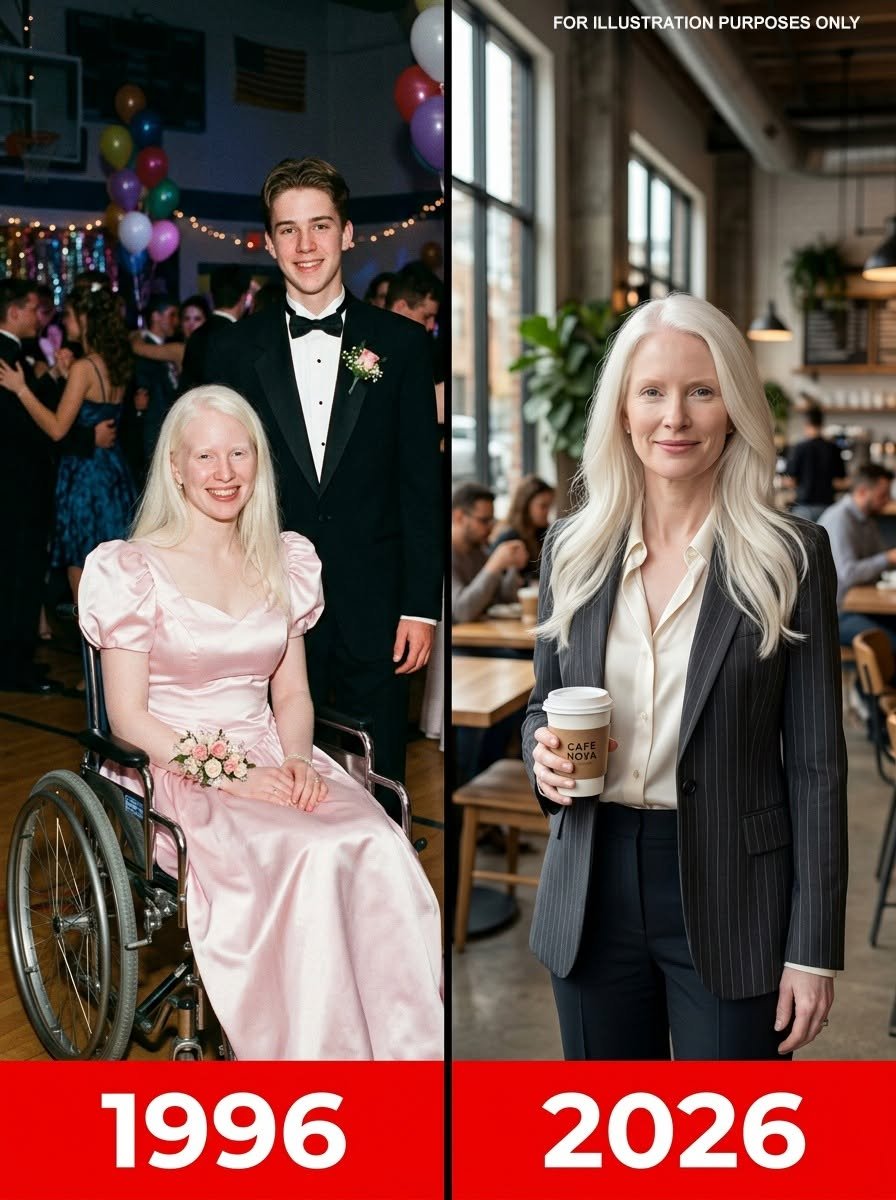
I had a knot in my stomach.
I took a closer look.
Her tired eyes.
His familiar smile.
His slight limp.
My heart almost stopped.
Marcus.
Thirty more years.
Thirty more years.
I was working in a job that barely allowed me to pay my bills.
And he didn’t recognize me.
That night, I couldn’t stop thinking about him.
The boy who had given a broken teenage girl one of the most important moments of her life.
The next morning, I went home.
I found him washing the floor before opening time.
When he looked up, I finally spoke.
“Marcus… you once asked a girl in a wheelchair to dance when no one else wanted to.”
Her hands froze instantly.
The broom slipped from his fingers.
Her eyes widened.
“How do you know?”
I smiled through my tears.
“Because I was that girl.”
He turned livid.
We remained silent for several seconds.
Then he whispered:
” Oh my God… ”
And that’s when I learned the heartbreaking reason why this boy, who seemed destined for a bright future, had spent the last ten years barely surviving.
A reason linked to a secret sacrifice that no one knew about.
Not even his own family.PART 2
I never thought I’d see Marcus again.
At seventeen, a drunk driver ran a red light and everything changed in an instant. One moment I was worried about my exams, my dress, and my prom photos. The next, I was waking up in a hospital bed, surrounded by doctors who spoke cautiously and uncertainly.
My legs were fractured in several places. My spine was damaged. I heard words like rehabilitation , uncertain recovery , and possibility that no teenage girl should ever have to hear.
By the time of the end-of-year ball, I had already decided not to go.
I had nothing left there — or so I thought.
But my mother didn’t let me disappear quietly.
“You deserve a night,” she said, standing on my doorstep, my dress in her hand.
“I don’t want to be stared at,” I whispered.
“Then look at me,” she replied.
So I went.
She helped me get dressed, sat down in my chair, and took me to a gym full of music, laughter, and movement that seemed to belong to another world.
For the first hour, I stayed near the wall, watching others live this version of life that I thought I had lost.
People were coming and going. Smiling. Dancing. Forgetting my presence.
Then Marcus approached.
At first, I thought he was talking to someone behind me. I even turned around to check.
He stopped in front of me and smiled.
“Hey,” he said.
I hesitated. “You’re not in the right place.”
He laughed softly. “No, I think I’ve found exactly where I need to be.”
Then he looked at me with a more serious expression.
“Is hiding even a good thing if everyone can see you?”
Before I could answer, he held out his hand.
“Do you want to dance?”
My chest tightened. “Marcus… I can’t.”
He nodded once, as if it were an answer he had already prepared.”Okay,” he said. “Then we’ll see what the dance is like.”
And before I could protest, he gently pushed my wheelchair onto the dance floor.
As soon as we entered, I felt all eyes in the room on me.
“They’re staring at us,” I whispered.
“They were already staring at us,” he said. “It just makes things more authentic.”
That made me laugh despite myself.
He wasn’t dancing around me.
He danced with me.
He slowly swiveled my chair. He followed the rhythm. He made the moment shared rather than separate. For the first time in months, I was no longer an object of contemplation; I was fully integrated into the room.
When the song was over, he led me back to my table and sat next to me.
“To be clear,” I said, still trying to breathe normally, “this is completely insane.”
“Just to be clear,” he replied with a smile, “you’re smiling.”
After that night, he disappeared when my family left to receive medical treatment.
My life has been defined by surgeries, rehabilitation, and years of learning to live with a transformed body. I learned to transfer myself, to move around with braces, and to gradually rebuild my independence. I also learned something else: how quickly people move on when your life becomes difficult to understand.
University studies took longer. Everything took longer.
But the anger never left me, and I transformed it into architecture – designing spaces that don’t surreptitiously exclude people like me. Buildings that don’t presuppose that everyone moves around the world in the same way.
By the age of fifty, I had built a career, a business and a reputation in the field of accessibility, a reputation that truly respected the people it purported to serve.
And I thought that chapter of my life — the one with Marcus — was over forever.
Until the day I walked into a cafe.
It was supposed to be a normal stop. I spilled coffee everywhere. Someone rushed over with napkins and a mop.
He was limping.
Wearing a medical blouse under a cafe apron.
Il resto è nella pagina successiva
