
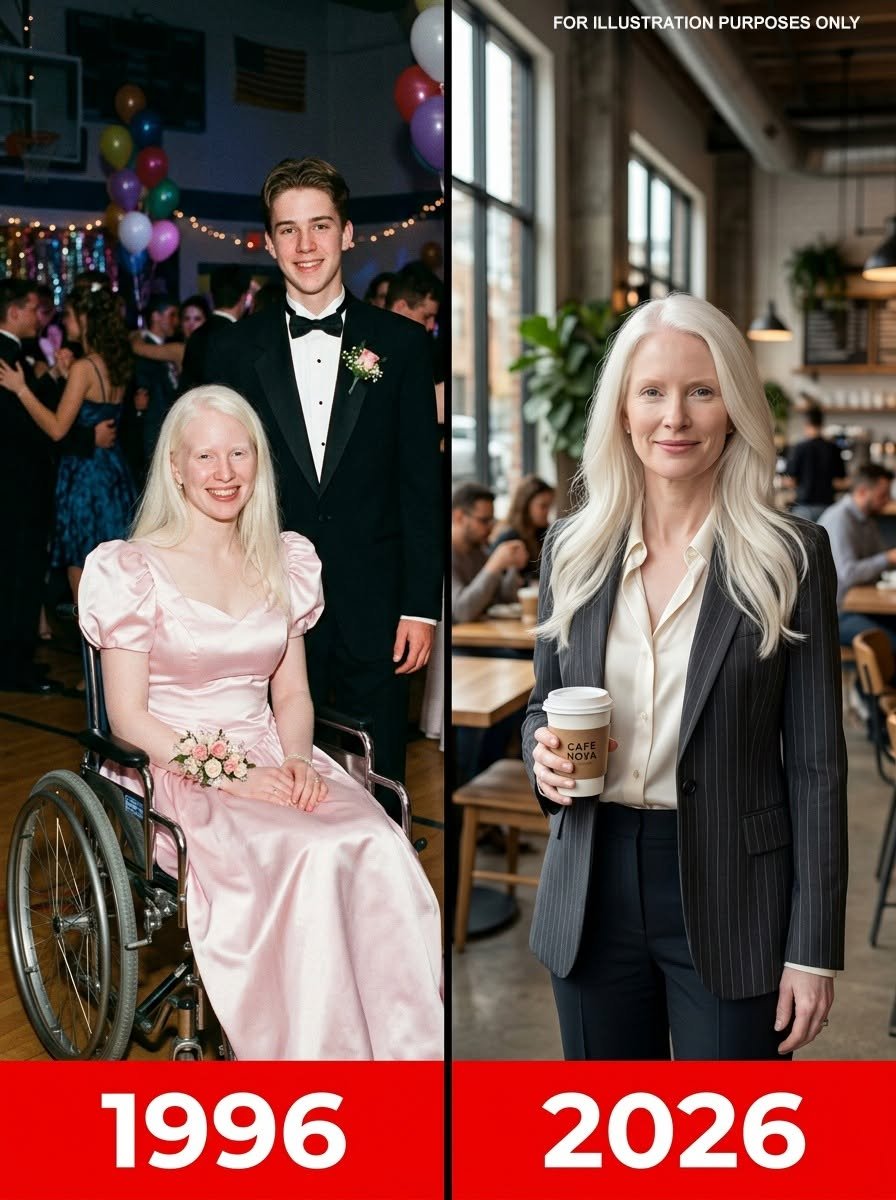
There was something familiar about him even before I understood why.
He looked up at me for a brief moment and said, “Excuse me… you look familiar.”
But he didn’t remember it.
Not yet.
I came back the next day.
And the next day.
Finally, I said it.
For illustrative purposes only
“Thirty years ago, you invited a girl in a wheelchair to dance at the prom.”
His hand froze mid-movement.
Slowly, he raised his eyes.
“Emily?” he said.
And just like that, time collapsed.
We talked.
He told me what happened after prom: how his life turned into a struggle for survival. His mother got sick. Money started running out. Football no longer mattered. Everything had lost its importance, except survival.
“I thought it was temporary,” he said. “And then one day, I looked up and I was fifty years old.”
He was not bitter.
I’m simply tired.
But always friendly.
Always him.
Over the following weeks, we continued to meet. To talk. To get to know each other again in fragments.
I offered him my help. He initially refused.
“It’s charity,” he said.
“No,” I replied. “It’s an opportunity.”Finally, he accepted a consultant position on an adaptive design project at my firm. Not because he had confidence in the offer, but because deep down, he trusted me.
His intervention changed everything.
He didn’t speak from theory, but from experience. He questioned projects that seemed perfect on paper but failed in reality. He reminded us that accessibility is not a matter of conformity, but of dignity.
And slowly, something inside him began to change too.
He finally received the medical care he had neglected for years. His knee was properly treated for the first time in decades. The constant pain didn’t disappear, but it no longer dictated his every step.
One afternoon, sitting on the sidewalk in front of a clinic, he said softly, “I thought this was it, my life now.”
I sat down next to him. “That was your life. It doesn’t have to be the whole story.”
That was the turning point.
Not dramatic.
Simply authentic.
From there, he began his reconstruction, not only physical but also social. He mentored and advised injured young people. He contributed to staff training. He became the voice he himself would have needed when he was younger.
And in the middle of all that, we found each other again.
Not as teenagers.
Not in the form of a souvenir.
But also two adults shaped by time, loss, and survival.
One evening, I found an old photo of the two of us taken at the prom and I brought it to work without thinking.
He saw it and remained silent.
“Did you keep that?” he asked.
“Of course.”
Then, after a long silence, he said something I wasn’t expecting.
“I tried to find you after high school.”
I was breathless. “You did it?”
“Yes,” he said. “But life quickly became cramped. My mother fell ill. And everything else followed.”
I stared at him. “I thought you’d forgotten about me.”
He seemed genuinely perplexed.
“Emily,” he said softly, “you were the only girl I ever tried to find again.”
And something inside me finally released after thirty years of unconscious resistance.
Now, we’re not rushing anything.
We are not trying to rewrite the past.
We simply live in the present — with caution and honesty, without pretending that life has ever been simple.
During the inauguration of our community center, music was played in the main hall.
He approached me, as he had done all those years before, and held out his hand.
“Do you want to dance?” he asked.
I smiled.
This time, there was no hesitation.
“We already know how,” I said.
And we did it.
Il resto è nella pagina successiva
